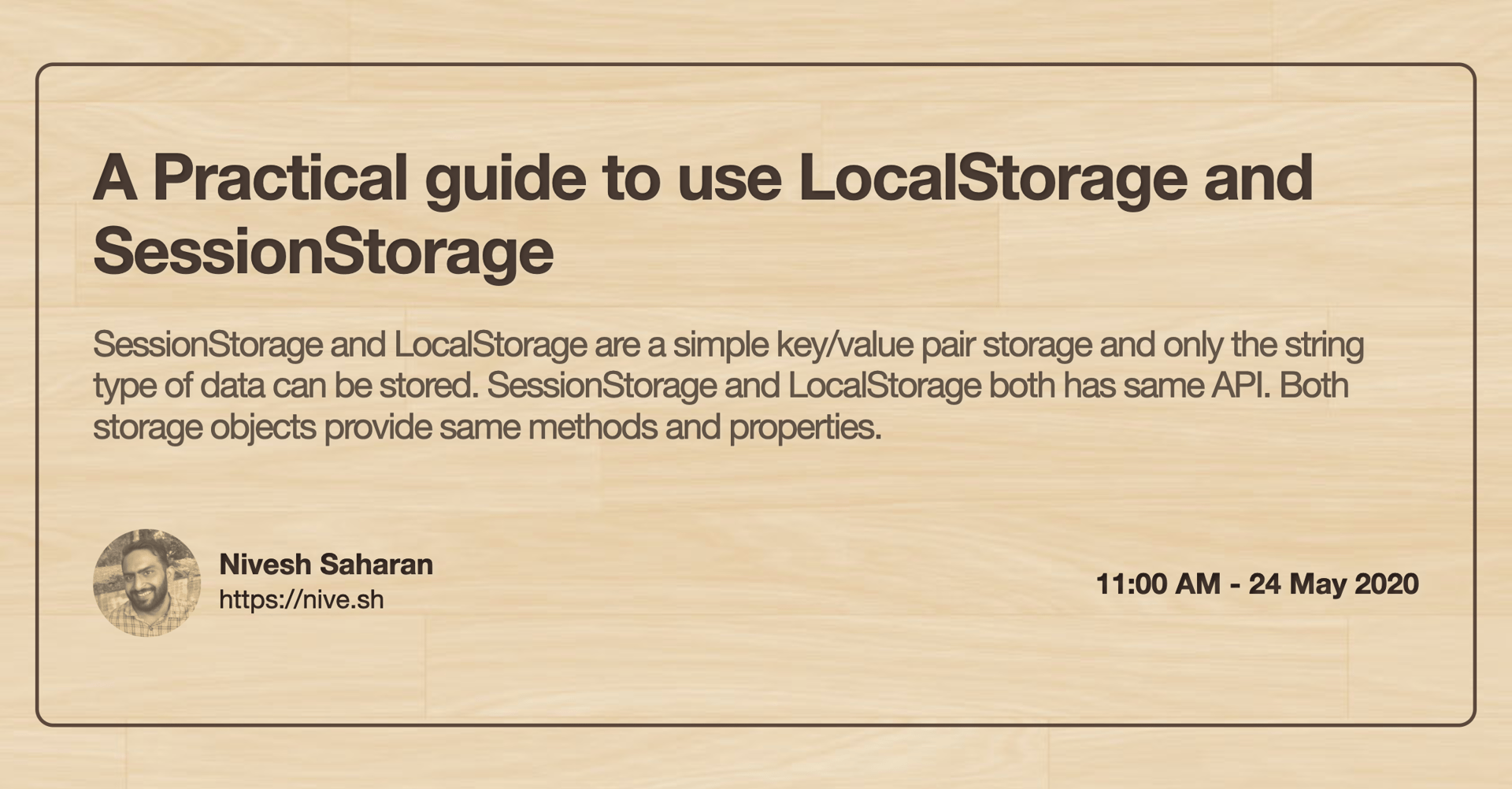
A Practical guide to use LocalStorage and SessionStorage
SessionStorage and LocalStorage are a simple key/value pair storage and only the string type of data can be stored. SessionStorage and LocalStorage both has same API. Both storage objects provide same methods and properties.

SessionStorage
SessionStorage is a simple key/value pair storage and only the string type of data can be stored. It is a tab specific storage and the data stored in SessionStorage will be lost when that tab is closed. We can store upto 5MB of data in this storage. Data stored in SessionStorage cannot be accessed from another tab.
LocalStorage
LocalStorage is also a simple key/value pair storage and only the string type of data can be stored. The data stored in LocalStorage is shared between all tabs for same domain. There is no expirations for the data in LocalStorage so it is always there even if you close the tabs or restart your system.
Check if the browser supports it
if(typeof(Storage) !== void(0))
{
  // Your browser support localStorage and sessionStorage
}
else{
  // Sorry! No web storage support..
}Storage API
SessionStorage and LocalStorage both has same API. Both storage objects provide same methods and properties. Following examples shows the API usage for localStorage and since they use same API, feel free to replace localStorage with sessionStorage
Store an Item
// Store a simple string
localStorage.setItem('my-key', 'my-value');

// Store an object (Must be converted to string)
localStorage.setItem('my-object-key', JSON.stringify({key: 'value'}));Get an Item from Storage
localStorage.getItem('my-key'); // Returns string: 'my-value'

localStorage.getItem('my-object-key'); // Returns string: '{"key":"value"}'

JSON.parse(localStorage.getItem('my-object-key')); // Returns object: {key:"value"}Remove an item
localStorage.removeItem('my-key');The number of stored items
localStorage.length // Return count of items storedGet the key on a given position
localStorage.key(0); // Returns key of the item at very first positionGet all keys
Object.keys(localStorage); // Returns array of all keysGet all items
for(let i = 0; i < localStorage.length; i++){
  const key = localStorage.key(i);
  const value = localStorage.getItem(key);
  console.log(key, value)
}Remove everything from storage
localStorage.clear(); // Removes everything from localStorageStorage Event
When the data gets updated in LocalStorage or SessionStorage, the storage event is triggered with following properties:
key- The name of key that was changed. (It will benullif.clearwas called)oldValue- The old value of changed key. (It will benullif it is newly added)newValue- The new value of changed key. (It will benullif the key was removed)url- The URL where the change happenedstorageArea-localStorageobject orsessionStorageobject depending on where it was updated.
Storage event is triggered on all window objects of same domain excepts the one that triggered it.
Listen for events
window.addEventListener('storage', function(e){
  console.log(e.key, e.oldValue, e.newValue, e.url, e.storageArea)
});Storage event triggered when the value is actually changed. Setting same value won't trigger the event.
Listen for a specific key change
window.addEventListener('storage', function(e){
  if(e.key === 'my-key')
  {
    // Do your thing
  }
});Things to remember
LocalStorageandSessionStorageallow to store key/value (Stringonly).- Storage event triggers on
setItem,removeItem,clearcalls. - The event triggers on all
windowobjects where the storage is accessible, except the one that caused it. - Refreshing the page doesn't remove data from
SessionStorage - Closing the browser or rebooting your system doesn't remove data from
LocalStorage - Do not store sensitive user information in
LocalStorageorSessionStorage